 Photo Courtesy: nenow
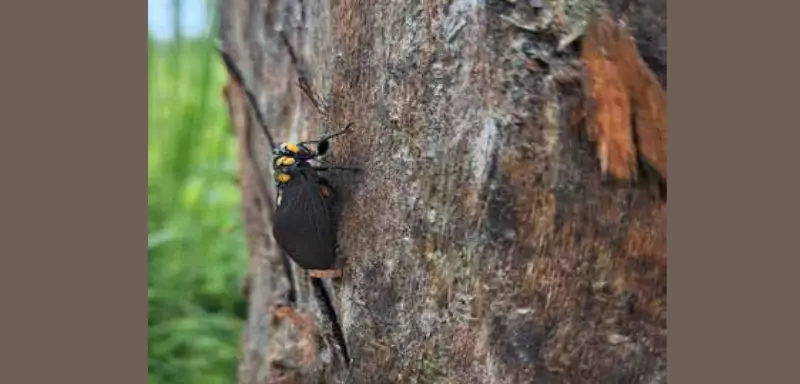
Guwahati: A rare black-and-golden cicada now inhabits India. Researchers documented the Huechys fusca for the first time in Assam’s Manas National Park. The team included Koushik Rajbongshi, Jonmani Kalita, and Karan Barman from Aaranyak, plus Dhritiman Das from the Durrell Wildlife Conservation Trust. They published these findings in the July 2026 issue of Zoo's Print.
The sighting occurred on May 20, 2024, at 10:50 am. The crew spotted the insect near the Bangale Hat-Dhuwa forest camp in the Bansbari range. It sat on an Okshi tree for one minute before flying off. The researchers identified it as Huechys fusca Distant, 1892. Previously, scientists only saw this insect in Singapore, Borneo, the Malay Peninsula, and Sumatra.
India hosts 204 known cicada species. The genus Huechys includes 24 living species globally. Five of these existed in India, Bangladesh, and Myanmar before this discovery. Assam already hosted three: H. beata, H. sanguinea, and H. thoracica. Researchers noted that the state's insect diversity remains under-studied. They stated, "For Assam's researchers, the tiny cicada has opened another window into the still largely unexplored biodiversity of Manas."
The team found the insect in a low alluvial savannah woodland. This habitat features grasses like Saccharum narenga and trees such as Bombax ceiba. Manas spans 500 square kilometers across the Chirang and Baksa districts. As a UNESCO World Heritage Site and Tiger Reserve, the park requires strict protection to maintain its varied wildlife. This record proves that even well-known parks hold secret species waiting for documentation.
Updated at 12th August 2026 at 2:01pm
Koushik Rajbongshi, Jonmani Kalita, and Karan Barman represent the Threatened Species Recovery Programme at Aaranyak, while Dhritiman Das operates through the Pygmy Hog Conservation Programme. The team observed the insect on a girdled Okshi tree trunk under clear, sunny conditions.
Beyond the previously noted vegetation, the alluvial savannah woodland site also contains Imperata cylindrica, Apluda mutica, Arundinella nepalensis, Careya arborea, and Gmelina arborea. The discovery also highlights the importance of protecting the park's grasslands and forests to preserve species beyond the high profile tigers, rhinos, and elephants that usually draw the headlines.







Comments