 Photo Courtesy: India Today Group
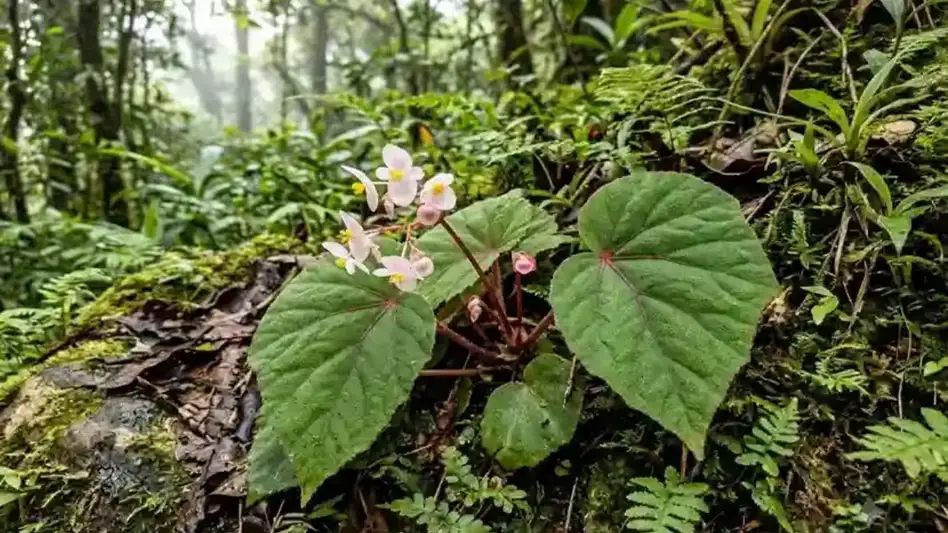
Itanagar: Researchers found a new Begonia species in the Keyi Panyor district of Arunachal Pradesh. Officials confirmed the discovery on Friday, September 25. The plant is called Begonia neelamorum. Experts Dipankar Borah, Madhusudhan Khanal, Momang Taram, and Neelam Gap documented the find. Their work appeared in the journal Taiwania.
The team located the small tuberous plant on steep, damp walls along the Keyi River at 1,000 metres elevation. Locals call the plant kobiirhopu baabrai. The species honors the Neelam clan of the Nyishi community, which helped the team during their expedition. It grows in a tiny area of only three square kilometres.
The plant features a single, sessile, light-green leaf. It blooms with white male and female flowers. While it looks like Begonia prolifera, researchers noted distinct traits. The plant sports glandular hairs, a rounded stem, and ovate leaves with double-serrated margins. It also features shorter styles and a unique inflorescence structure.
The International Union for Conservation of Nature has provisionally tagged the plant as Data Deficient. Experts stated, “there is currently insufficient information to determine its conservation status more precisely.”
This discovery brings the count of documented Begonia species in Northeast India to 54. The genus contains about 2,200 accepted species globally, primarily in tropical and subtropical regions.
Updated at 25th September 2026 at 9:53pm
Botanists recently identified a second distinct species in Arunachal Pradesh. A team found the herb Didymocarpus nautiyalii in the Shi-Yomi district during an April 2025 survey. This plant grows to roughly 8 centimetres and features bluish-purple flowers. It favors moist rock surfaces and roadside walls above 1,000 metres.
Madhusudhan Khanal led the effort, which included researchers Devendra Kumar, Santosh Kumar Rai, Niku Das, Dipankar Borah, and Momang Taram. They named the plant after Professor Sunil Nautiyal, the former director of the G.B. Pant National Institute of Himalayan Environment. Field teams initially confused the plant for a Henckelia species before confirming it belongs to the Didymocarpus genus.
The team found only 19 individuals across two small pockets, covering an area of roughly 4 square kilometres. Like the Begonia discovery, experts have tagged this species as Data Deficient. Researchers are calling for more field work to see if the plant exists elsewhere in the Shi-Yomi area.






Comments