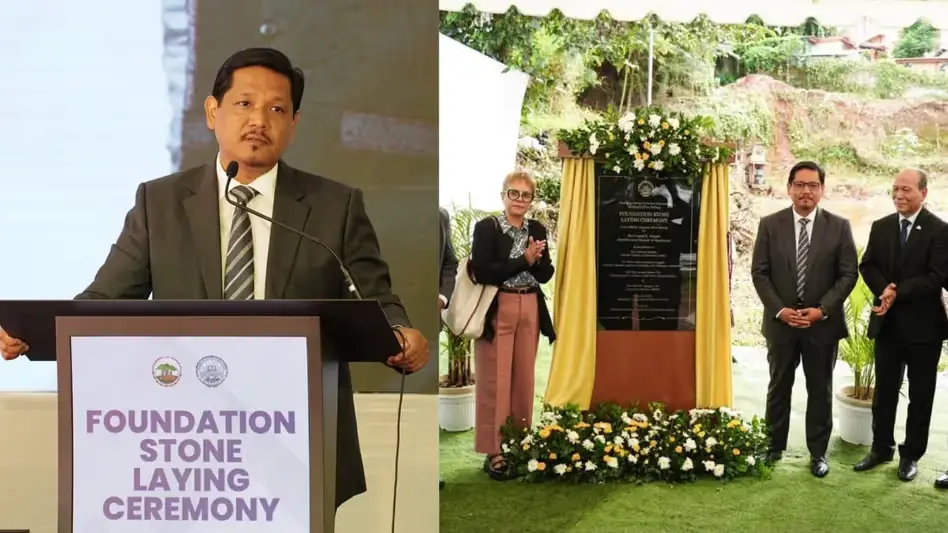
 Photo Courtesy: India Today Group
Shillong: Meghalaya Chief Minister Conrad K. Sangma pushed a major education overhaul on September 23. He launched an AI-powered CM IMPACT guidebook to boost student learning. The new resource includes subject-specific material for SSLC examinations. The state government also pushed out Rs 49.78 crore in Direct Benefit Transfers under the Samagra Shiksha Abhiyan. This cash covers school uniforms, textbooks, composite school grants, and inclusive education funding.
Sangma broke ground for a new Meghalaya Board of School Education regional office at the Education Complex in Laitumkhrah, Shillong. The board had operated from a temporary space for 45 years. "After 45 years of its operations from a temporary building, glad to lay foundation for the Shillong Regional Office of the Meghalaya Board of School Education (MBOSE) at the Education Complex, Laitumkhrah," Sangma said. This office will support board functions and improve the local education system.
The government also shifted its focus to building new classrooms. Sangma virtually inaugurated infrastructure for 82 government schools under the second phase of Mission Education. Many of these sites lacked proper buildings for decades. The initiative aims to bring every government school to a defined standard. Sangma confirmed that "big change begins with one step at a time." He noted that current efforts include Mission Education, Mission School, CM IMPACT, and digital learning programs to improve exam outcomes.
Updated at 24th September 2026 at 5:50pm
The MBoSE regional office in Shillong has bounced between temporary quarters since its 1981 launch. It started at the Inspector of Schools office in Mawkhar, moved to the Education Guest House in Laitumkhrah in 1995, shifted to the MBoSE Guest House in 1998, and settled in the Taxation Building at Lower Lachumiere in 2005. The office now manages 1,329 secondary and 397 higher secondary schools across seven districts, overseeing 175 exam centers and coordinating over 1,300 examiners annually.
Mission Education has committed Rs 457.41 crore across 2,230 schools. This includes Rs 109.33 crore for 208 schools in phase one, Rs 97.38 crore for 111 schools in phase two, and various tranches through the Engineering Cell and MIDFC. Additionally, 182 schools received digital upgrades through Asian Development Bank support. To improve resource distribution, the state pruned its school network from 14,582 to 11,443 by merging institutions with zero or single-digit enrollment. Officials also boosted the count of higher secondary schools from 427 in 2024 to 545 for the 2025-26 academic year.
Financial aid under the Samagra Shiksha Abhiyan includes a Rs 17.88 crore uniform grant for 298,013 students. Specific support for children with special needs reached Rs 57.62 lakh, funding transport, escort allowances, and stipends for 3,440 beneficiaries. Sangma linked these moves to a life-cycle welfare strategy that starts before birth and continues through higher education, including a scholarship scheme for nearly one lakh students and an open door for private candidates of any age.
Performance metrics show improvement, with the state's PGI 2.0 score climbing from 448 in 2024 to 525.71 in 2026. Sangma aims to crack the national top 10 within two years. Addressing the planning process, the Chief Minister cited a Japanese model of prioritizing rigorous preparation to maximize the impact of limited public funds.


Comments