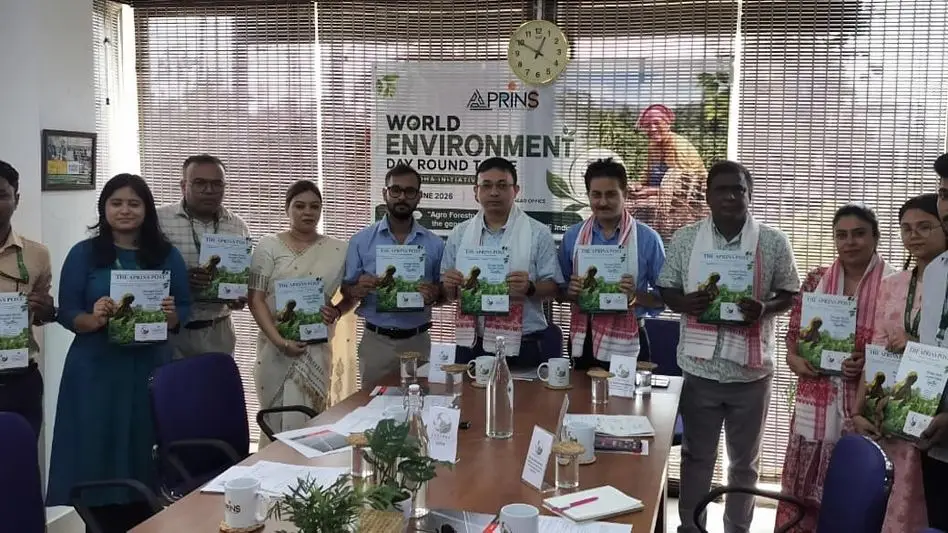
 Photo Courtesy: India Today Group
Guwahati: Experts recently gathered at a high-level roundtable to address the future of agroforestry in Northeast India. Organized by the APRINS Vasudha Initiative on June 6, 2026, the event aimed to identify critical gaps and establish a roadmap for sustainable land-use practices. Participants included representatives from The Energy and Resources Institute, GIZ India, the National Rural Livelihoods Mission, and the United Nations Development Programme.
APRINS Managing Director Chandan Borthakur opened the session by reaffirming the organization's focus on ecological restoration and climate resilience. The discussion highlighted the need for bridging scientific research with traditional farmer-led techniques. Dr. Naba Kumar Goswami of TERI emphasized that merging these two fields is essential for long-term success in the Himalayan and Northeast regions.
Technical insights also came from GIZ India, which showcased how sustainable aquaculture can be integrated into existing agroforestry landscapes. A. Mannan Choudhury of NRLM, drawing on successful pilot programs in Bihar and Jharkhand, argued that community institution-building is the foundation of any measurable, lasting impact. Sounika Karmakar, representing the UNDP-GEF programme, noted that local engagement is vital for project viability. She stated, "Farmer participation and local ownership must remain central to the development and implementation of any agroforestry roadmap for the region."
The event concluded with a focus on overcoming regional barriers to adoption through better coordination among government bodies and agricultural stakeholders. By fostering collaboration, organizers hope to strengthen livelihoods while addressing the growing challenges of climate change across the Northeast.





Comments