
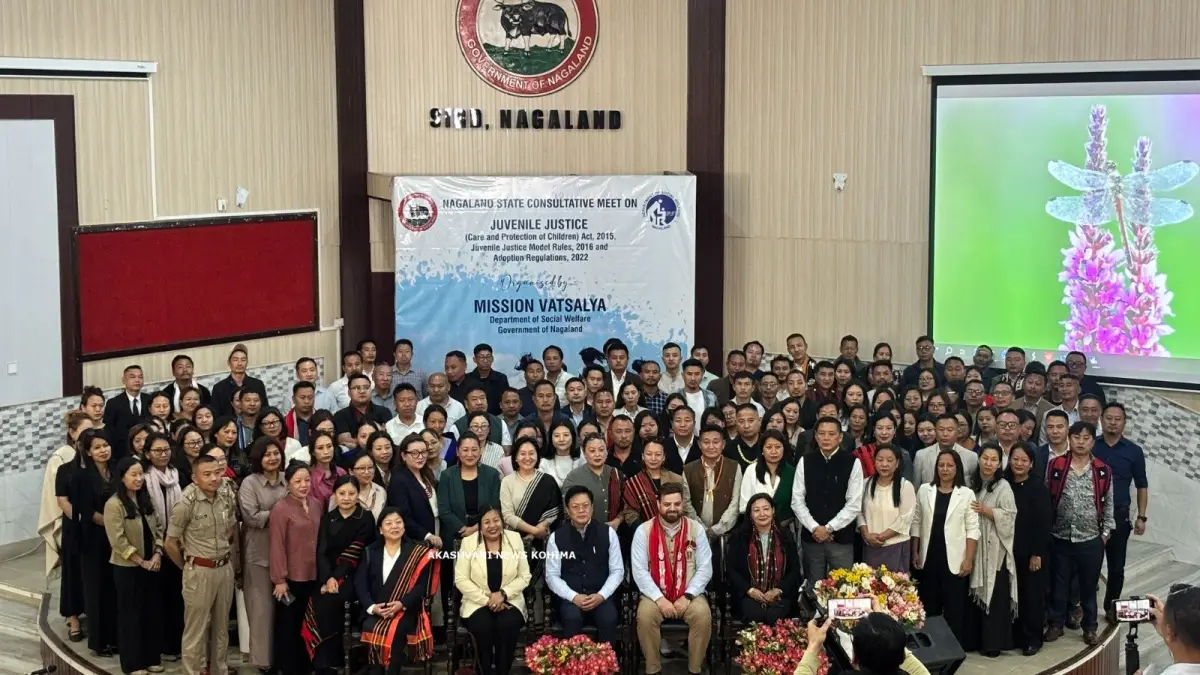
 Photo Courtesy: northeasttoday
Kohima: A state-level consultative meeting was held in Kohima on Tuesday to address the implementation of the Juvenile Justice (Care and Protection of Children) Act, 2015, the Juvenile Justice Model Rules, 2016, and the Adoption Regulations, 2022. Organized by Mission Vatsalya and the Department of Social Welfare, the event brought together diverse stakeholders including police officials, district administrators, members of the Nagaland State Commission for Protection of Child Rights, the judiciary, and representatives from various Child Care Institutions.
Addressing the participants, Social Welfare Secretary and Mission Director Limawabang Jamir emphasized the necessity of creating a framework that is legally robust while remaining culturally sensitive. He noted that Nagaland holds a unique position under Article 371A of the Indian Constitution, which protects traditional institutions and customary practices. Jamir argued that while the formal legal structure is essential, its success in the state depends on reconciling statutory requirements with the realities of remote geographical areas, digital infrastructure gaps, and deep-rooted clan traditions.
The discussion highlighted that while informal customary adoptions are a cornerstone of Naga society, they can sometimes leave children vulnerable regarding legal identity, inheritance, and welfare entitlements. Jamir urged a collaborative approach between tribal bodies, churches, and government departments to bridge the gap between formal mandates and traditional community-based care systems. Social Welfare Director Tosheli Zhimomi echoed these sentiments, stating that the consultation was vital for improving interdepartmental coordination to better serve the state's youth.
Junaid Ul Islam, a senior consultant at the Ministry of Women and Child Development, noted that Nagaland is the first state to initiate such discussions regarding proposed amendments to the Juvenile Justice framework. The central government is actively seeking feedback from the state to ensure that future regulations are both practical and responsive to the specific cultural context of the region.



Comments