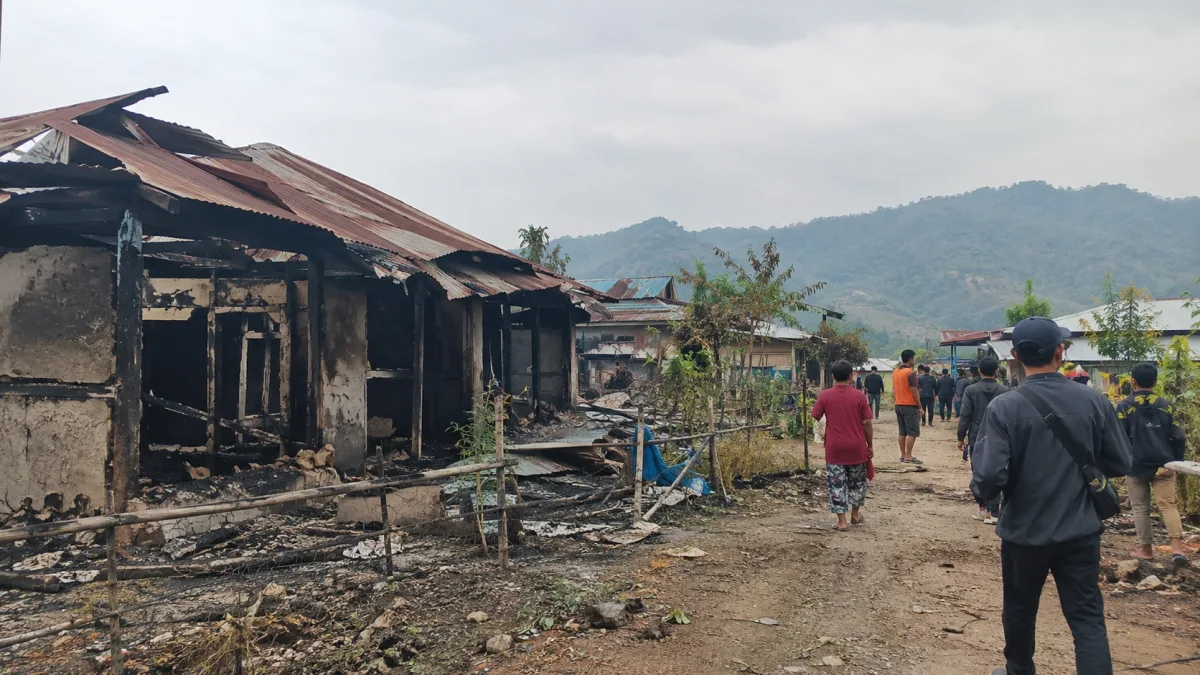
 Photo Courtesy: Representative Image
More than three years on, Manipur’s conflict tests New Delhi’s ability to restore stability, secure peace and advance regional ambitions, writes Augustine.
The ethnic violence that erupted in Manipur in May 2023[1] has tested India’s ability to manage internal conflict while preserving political stability and advancing its regional ambitions. More than three years later after the ethnic violence between the Meitei and Kuki-Zo communities, the challenge is no longer simply to contain violence, but to make peace sustainable. Internally displaced persons (IDPs) must be able to return safely, livelihoods and essentials must be restored, and communities must regain confidence in living alongside one another. While, security deployments remain necessary, they cannot substitute for a political process that addresses the grievances sustaining the conflict.
The political transition has created an opportunity, but not a resolution. The Indian government established a Commission of Inquiry in June 2023 to investigate the causes and spread of the violence and examine possible lapses by responsible authorities.[2] President’s Rule (PR) was imposed in Manipur in February 2025 following the resignation of state Chief Minister N. Biren Singh.[3] The subsequent extension of extension of PR created a period of political uncertainty in Manipur.[4] PR was revoked in February 2026, and the return of elected government under Yumnam Khemchand Singh as state Chief Minister restored the elected state administration. Yet, renewed violence, protests, shutdowns and clashes with security forces in April 2026 highlighted the difficulties facing the administration with continuing insecurity and restrictions on movement shows the limits of political restoration.[5][6]
Then, the scale of displacement highlights the challenge. In September 2026, Chief Minister Yumnam Khemchand Singh told the state Legislative Assembly that approximately 36,000 IDPs had been resettled, while 24,000 remained in relief camps.[7] These figures indicate progress, but also show the scale of the remaining challenge. Meanwhile, violence spread to involve Nagas and Kuki-Zo communities in February 2026, highlighting the persistence of ethnic tensions and continuing concerns over security and accountability.[8] The government must therefore do more than resettle displaced families. It must strengthen protection, ensure fair rehabilitation and accountability, and pursue a credible political process capable of addressing the grievances that continue to divide communities.
Manipur’s immediate challenge is to turn rehabilitation commitments into safe and sustainable returns. The state’s 2026–27 Budget Speech outlined Rs.119 crore (approximately US$12.89 million as of March 9, 2026 USD/INR exchange rate) in top-up assistance for permanent housing for 7,000 displaced families, Rs.70 crore (approximately US$7.58 million) in compensation for 7,000 completely destroyed homes, Rs.60 crore (approximately US$6.50 million) for repairs to 8,000 partially damaged houses and Rs.274 crore (approximately US$29.68 million) for community assets in resettled villages.[9] These measures provide a basis for recovery, but their impact depends on implementation. Displaced families also need security in their areas of origin, restored livelihoods and reliable access to schools, healthcare, markets and transport. Without these conditions, financial assistance and resettlement figures alone cannot demonstrate that displaced families have returned to normal life or that communities can safely reconnect.
The consequences extend beyond Manipur. Instability in Manipur has already complicated India’s Act East Policy (AEP), which seeks to deepen economic and strategic ties with Southeast Asia. Manipur’s location on the Myanmar border makes it a key gateway for regional connectivity, particularly through Moreh Land Port.[10] The ethnic conflict has disrupted the Moreh–Tamu border market,[11] while the continuing conflict in Myanmar has further obstructed border trade and progress along the India–Myanmar–Thailand Trilateral Highway.[12] These overlapping crises complicate India’s regional ambitions. Stabilising Manipur is not only a domestic priority but also important first step for advancing India’s regional ambitions.
Manipur’s crisis shows why security deployments, financial commitments and the restoration of elected government cannot, by themselves, deliver lasting stability. The scale of the security response, including the Army and Assam Rifles, alongside nearly 20,000 Central Reserve Police Force (CRFP) personnel across approximately 200 companies and around 2,000 commandos from two Commando Battalion for Resolute Action (CoBRA) battalions[13] reveals the resources devoted to managing the crisis. The test for New Delhi and the state government is whether these security and political measures can be translated into safety, accountability, reconciliation and renewed public trust. Ultimately, Manipur is a test of Indian statecraft, and it will be judged by its ability to move beyond containing conflict and towards building a peace that communities can trust and sustain.
The Author, Mr. Augustine R K is an independent researcher whose research interests include geopolitics, foreign policy, conflict, security and strategic studies, with a particular focus on state strategy. His work has been published by Geopolitical Monitor, NIICE, and other outlets.
Footnote References
[1] International Crisis Group, “Finding a Way Out of the Festering Conflict in India’s Manipur,” https://www.crisisgroup.org/rpt/asia/south-asia/india/346-finding-way-out-festering-conflict-indias-manipur
[2] Press Information Bureau, Government of India, “Commission of Inquiry into the Incidents of Violence in Manipur,” June 2023, https://www.pib.gov.in/PressReleaseIframePage.aspx?PRID=1929742&lang=2®=48
[3] DD News, “President’s Rule Imposed in Manipur,” https://ddnews.gov.in/en/presidents-rule-imposed-in-manipur/
[4] Press Information Bureau, Government of India, press release concerning the extension of President’s Rule in Manipur, https://www.pib.gov.in/PressReleasePage.aspx?PRID=2159426&lang=2®=3
[5] The Indian Express, “In Manipur, Old Wounds Call for Repair, Not Containment,” https://indianexpress.com/article/opinion/editorials/in-manipur-old-wounds-call-for-repair-not-containment-10649014/
[6] Amnesty International, “India: Release All Hostages and End Cycle of Violence in Manipur,” June 2026, https://www.amnesty.org/en/latest/news/2026/06/india-release-all-hostages-and-end-cycle-of-violence-in-manipur/
[7] Press Trust of India, “36,000 IDPs Resettled, 24,000 Still Living in Various Relief Camps Across State: Manipur CM,” https://www.ptinews.com/detail/national/36-000-IDPs-resettled-24-000-still-living-in-various-relief-camps-across-state-Manipur-CM/4032046
[8] Human Rights Watch, “India: Renewed Ethnic Violence in Manipur,” 3 September 2026, https://www.hrw.org/news/2026/09/03/india-renewed-ethnic-violence-in-manipur
[9] Government of Manipur, Budget Speech 2026–27, https://manipur.gov.in/wp-content/uploads/2026/03/Budget-Speech-2026-27-Bilingual.pdf
[10] Land Ports Authority of India, “ICP Moreh,” https://www.lpai.gov.in/en/icp-moreh
[11] Observer Research Foundation, “Is Myanmar Impeding India’s Act East Policy?” https://www.orfonline.org/expert-speak/is-myanmar-impeding-indias-act-east-policy
[12] The Irrawaddy, “Fighting Flares as Regime Tries to Secure India-Myanmar-Thailand Highway Route,” https://www.irrawaddy.com/news/burma/fighting-flares-as-regime-tries-to-secure-india-myanmar-thailand-highway-route.html
[13] The New Indian Express, “After Assam Rifles Attacks, CRPF Overhauls Manipur Deployment SOP, Boosts Force Protection,” 17 July 2026, https://www.newindianexpress.com/amp/story/india/2026/Jul/17/after-assam-rifles-attacks-crpf-overhauls-manipur-deployment-sop-boosts-force-protection




Comments