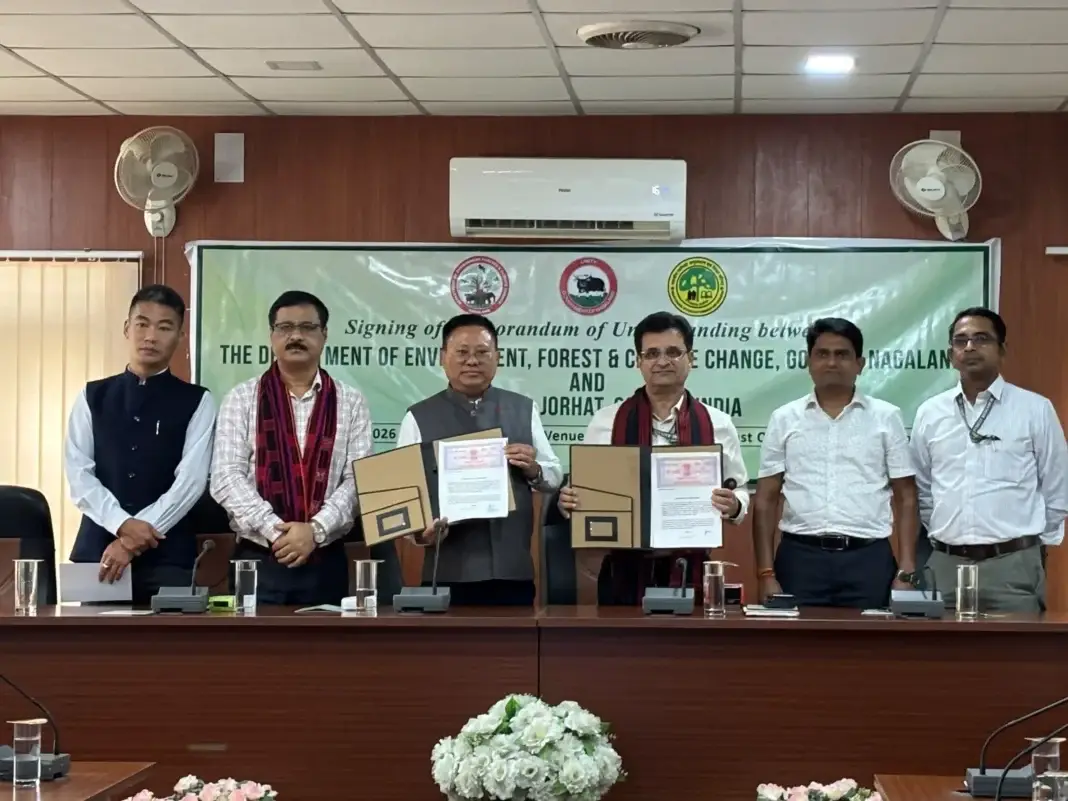
 Photo Courtesy: nagalandpost
Kohima: The Nagaland Department of Environment, Forest and Climate Change (EFCC) inked a deal with the Indian Council of Forestry Research and Education Rain Forest Research Institute (ICFRE-RFRI) on August 1. The agreement, signed at the Forest Office Complex in Dimapur, seeks to overhaul agarwood farming across the state. Principal Secretary Y. Kikheto Sema signed for Nagaland, while Director Dr. Nitin Kulkarni represented the Jorhat-based institute.
Nagaland historically held only a two percent share of the national agarwood quota. Neighboring Assam claims 80 percent, while Tripura holds 15 percent. Local farmers often lost profits to traders from other states due to a lack of formal policy and processing infrastructure. "Because we lacked a policy, people from Assam would come and take our Agarwood away," Sema said. The state cabinet approved a dedicated Nagaland Agarwood Policy on May 6 to fix these gaps.
The partnership brings scientific rigor to local plantations. Both entities will conduct soil testing and distribute quality saplings. They plan to train farmers in systematic harvesting and trading to increase potential revenue by 40 to 50 times compared to traditional jhum cultivation. Crucially, the deal introduces RFRI's artificial inoculation technology, which boasts a 90 percent success rate. This move cuts out private entities that previously charged high fees for the service.
Chief Conservator of Forests Sidramappa Chalkapure noted that the collaboration follows guidance from Union Minister of State for Environment, Forest and Climate Change Kirti Vardhan Singh. Beyond agarwood, the state intends to work with RFRI on clonal teak. These trees mature in 20 years, slashing the wait time of traditional 40 to 50-year cycles. The institute will also survey regional resources to support agroforestry, allowing farmers to grow multiple crops simultaneously.



Comments