 Photo Courtesy: India Today Group
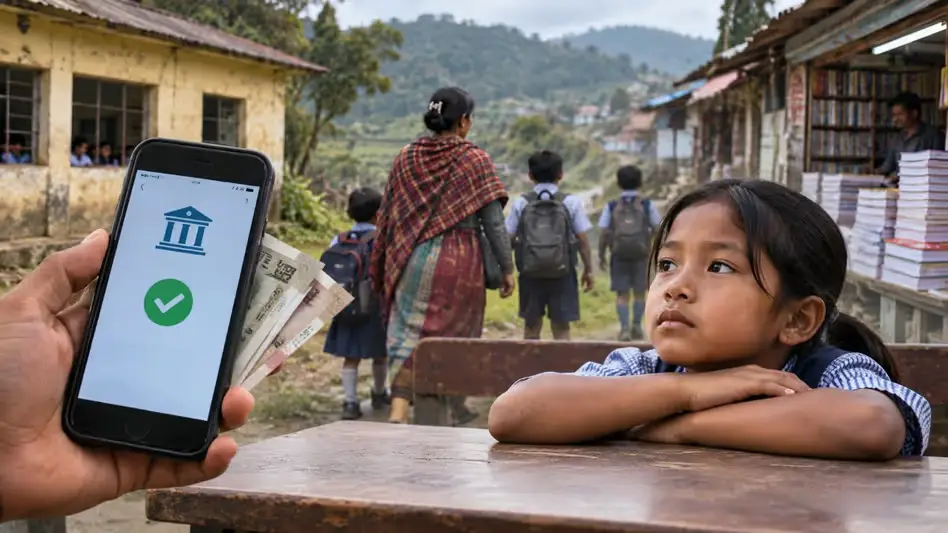
Shillong: The Samagra Shiksha initiative in East Khasi Hills issued a directive on September 28, 2026, mandating that textbook grants be paid only through direct benefit transfers. This policy affects 519,816 students across Meghalaya. Families will now receive Rs 250 for children in Classes I through V and Rs 400 for Classes VI through VIII instead of receiving physical books.
The shift imposes ten specific requirements on parents. They must possess an Aadhaar number, a linked bank account, and be identified as a guardian. The program also enforces a two-child cap on transfers. Given that the state's rural fertility rate is 3.3, many children remain ineligible. Furthermore, parents must locate books from distant publishers and prove the purchase to teachers during the busy winter season.
The administrative hurdles are significant. Many rural residents lack reliable banking, and the state's minimum wage of Rs 541 makes travel to procure books financially damaging. Commissioner and Secretary of Education Vijay Kumar Mantri faces scrutiny for the policy, which lacks a published rationale or impact assessment. The department has not provided estimates on how many families might be excluded. Records show Bihar abandoned a similar scheme in 2022 after finding that only 18 per cent of students successfully used the cash to purchase books.
Timing remains a critical failure. The grant is earmarked for the 2026-27 financial year, but the school calendar runs from February to December. If the funds apply to 2027, the money arrives months before book lists exist or school begins. Roughly 65,000 children advancing to Class VI and 56,000 moving beyond Class VIII will receive money for the wrong curriculum. About 77,000 incoming students will get nothing.
Meghalaya’s public schools serve the state's poorest families. Academic performance is already trailing national averages, with a primary dropout rate of 4.2 per cent. Experts argue that when direct supply fails, the government can track shortages. When cash transfers fail, the problem hides in thousands of households. "A child cannot learn from a bank credit," critics argue. "She learns from a book on her desk."


Comments