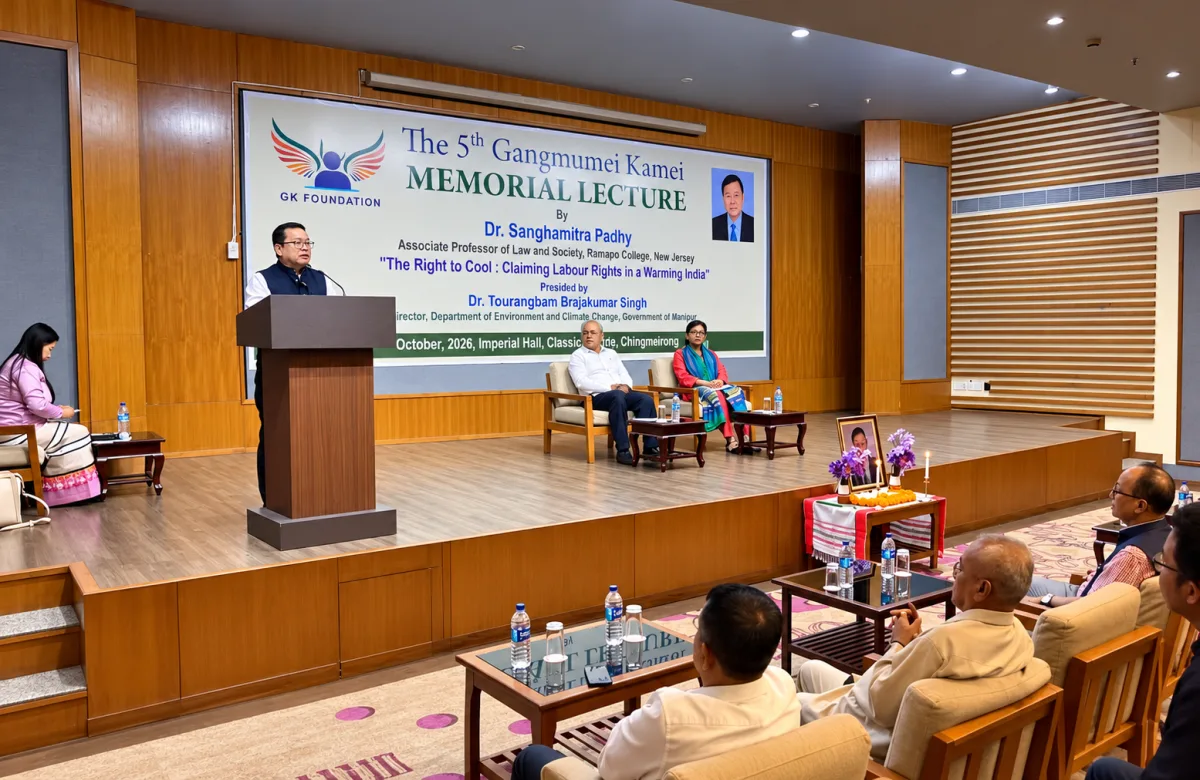
Imphal: Dr Sanghamitra Padhy delivers the 5th Gangmumei Kamei Memorial Lecture on the right to cool, welcomed by Shri Som Kamei, Trustee of the Foundation and Planning Advisor to the North Eastern Council.
Heat does not destroy property. It has no spectacle, no floodwaters, no collapsed roof. What it does, Dr. Sanghamitra Padhy told a hall in Imphal on Wednesday, is fall, quietly and repeatedly, on the bodies of people who cannot afford to stop working. And the law, she argued, has organised itself precisely so that it never has to see it.
Delivering the 5th Gangmumei Kamei Memorial Lecture at the Imperial Hall of Classic Grande, Chingmeirong, on the theme "The Right to Cool: Claiming Labour Rights in a Warming India," Padhy, Associate Professor of Law and Society at Ramapo College of New Jersey, USA opened with a personal debt. As a political studies student at Jawaharlal Nehru University, she had known Prof. Gangmumei Kamei, and remembered his charisma and intellectual wit, and the Manipuri chillies he carried to Delhi, which students treated as "commons" in the hostel. That heirloom seed, she noted, is now imperiled by rising temperatures, erratic rain and new pests "the seed not only holds life but is a chronicler of people's stories."
The lecture, held on Prof. Kamei's 87th birth anniversary and organised by the GK Foundation, then turned to its central claim. "Climate change has made record-breaking heat a life-threatening condition of outdoor laborers in India. Yet, heat remains invisible to law and goes unrecorded in legal, health and climate registries," Padhy said.
Her evidence moved between courtrooms and brick kilns. In Utkarsh Panwar v. CPCB, she noted, the National Green Tribunal shifted Delhi's brick-kiln operating season from winter to the summer months of March through June to fight air pollution, an order concerned with "livable air" that, in her framing, made heat illegible in the same stroke. Kiln work, she said, is performed largely by rural migrant workers, many of them women, without shade, cooling, housing or labour protections. One worker told her of days when kilns closed and wages disappeared, and days when work shifted to the night with no rest in between; many took paracetamol almost daily to keep working. "A worker with no residence paper and no labour code is actually illegible as a person too," Padhy said, while, by contrast, the Bureau of Energy Efficiency mandates central air-conditioning between 20°C and 24°C for courtrooms and Parliament.
She traced this "illegibility" to three legal failures: heat is not a pollutant, and so falls outside environmental law; the dry-bulb temperature used to declare heatwaves ignores humidity, radiation and the strain of physical labour, while the more accurate wet-bulb standard is reserved for elite sport and the US military; and Indian law has regulated indoor heat since the Factories Act of 1948, a 30°C wet-bulb ceiling, while leaving outdoor workers, nearly half the workforce, essentially unprotected. Heat action plans across roughly 23 states remain advisory. Citing The Lancet, she said heat is the world's leading weather-related killer, and that India lost some 181 billion potential labour hours to heat exposure in 2023, an income loss of over US$141 billion, borne mostly by agricultural and outdoor workers.
The lecture closed on litigation. Padhy devoted her sharpest analysis to a pending Supreme Court petition that centres labour rights in thermal injustice, invoking Articles 14, 21 and 47 and building on the court's own climate rulings to demand public cooling shelters, paid heat leave, shade and wage security, what activists have taken to calling the "right to cool." She was pointed about the Union government's decision in August this year to notify heatwaves as a natural calamity: naming heat "natural," she argued, "forecloses accountability before it starts." In her words: "With no one to blame, there is no one to claim."
The Imphal resonance was deliberate. Citing a reported account of a vendor who has sold local delicacies at Kwairamband Keithel for over two decades, Padhy noted how extreme heat, and the curfews and shutdowns that have marked Manipur's recent years, compound each other for those whose stock perishes unsold, and observed that Manipur does not figure among the states officially listed as heatwave-vulnerable, even as no heat-stroke deaths have been formally recorded. "Stories from below tell us that the reality is very different."
Presiding over the function, Dr. Tourangbam Brajakumar Singh, Director of the State's Department of Environment and Climate Change, echoed the frame, describing the right to cool as an emerging framework that "should be a fundamental right under Article 21 of the Constitution," and outlining steps his department is taking, a state heat action plan with a health-sector focus, water ATMs, mobile cooling stations and green cover, while stressing that around 80 per cent of Manipur's workers labour outdoors.
Som Kamei, Trustee of the Foundation and Planning Advisor to the North Eastern Council, delivered the welcome address and introduced the speaker; the vote of thanks was proposed by Dr. Jenpuiru Kamei, Assistant Professor at Modern College, Imphal.
The session also carried a quiet footnote of its own time and place: dignitaries and invitees made their way to the venue, the vote of thanks noted, "despite the prevailing bandh and transit disruptions." Asked in the discussion what citizens can do, Padhy's answer stayed close to Prof. Kamei's own method: document. "When there is no record, there is no problem for the law."
The lecture was streamed live by NEWire.in and can be viewed in full on the publication's YouTube channel:



Comments