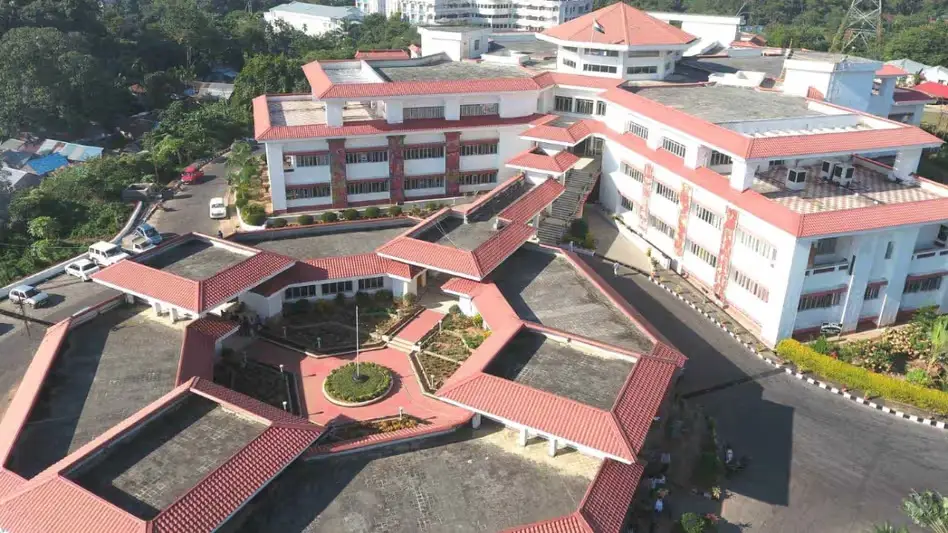
 Photo Courtesy: India Today Group
Agartala: The Tripura High Court ordered the state government to enforce strict CCTV compliance in every police station. Chief Justice M S Ramachandra Rao and Justice Biswajit Palit issued the mandate following a brutal custodial assault. Saikat Saha was allegedly beaten at East Agartala Police Station on the night of April 4. His mother, Ratna Roy, filed the petition. She claimed an Agartala Municipal Corporation employee, Rabindranath Ghosh, and Special Police Officer Joy Debnath dragged her son into the station for torture.
A Special Investigation Team formed on May 14 confirmed the assault occurred. The court verified the findings using seized footage. Officials fired Ghosh and Debnath after the report. Police officials involved in the abuse faced suspensions and formal departmental charges. The Bench also addressed a separate, concerning case where no footage existed during an alleged assault. The court said the issue came to light during the hearing of that matter and stressed the need to ensure that such a situation does not recur.
Judges ordered cameras to cover entry points, lock-ups, corridors, and offices. The systems must feature night vision and audio recording. Footage must remain stored for at least 18 months. Each station Officer-in-Charge bears full responsibility for these systems. If a camera breaks, they must notify the District Level Oversight Committee immediately. The Officer-in-Charge must also report any interrogations conducted during equipment outages. The court reminded the government that state finance departments must fund these upgrades to meet national standards.
Updated at 18th September 2026 at 2:04am
The court explicitly tied its latest directives to the Supreme Court's 2020 judgment in Paramvir Singh Saini v. Baljit Singh and Others. This move forces the state to implement those national guidelines in letter and spirit. Judges specified that the mandatory camera coverage must extend to main gates, reception areas, verandas, station halls, and the offices of Inspectors and Sub-Inspectors.
To manage the tech, the court defined a clear chain of command. If a camera dies, the Officer-in-Charge must report the gap to the District Level Oversight Committee, which is headed by the Divisional Commissioner. That committee must then immediately petition the State Level Oversight Committee to trigger repairs or buy replacement gear. The court also clarified that storage must last 18 months, though it set a one-year minimum for cases where 18-month retention is commercially impossible.
Updated at 18th September 2026 at 9:49pm
The court clarified that when a camera goes dark, the Officer-in-Charge must now track and report every arrest and interrogation conducted during the outage. These records must be sent directly to the District Level Oversight Committee without delay.
"The Officer-in-Charge of P.S. has to be made responsible for the CCTV data maintenance, backup of data, fault rectification, etc.," the order stated. This mandate forces the committee, led by the Divisional Commissioner, to immediately petition the State Level Oversight Committee to authorize repairs or secure replacement hardware.





Comments