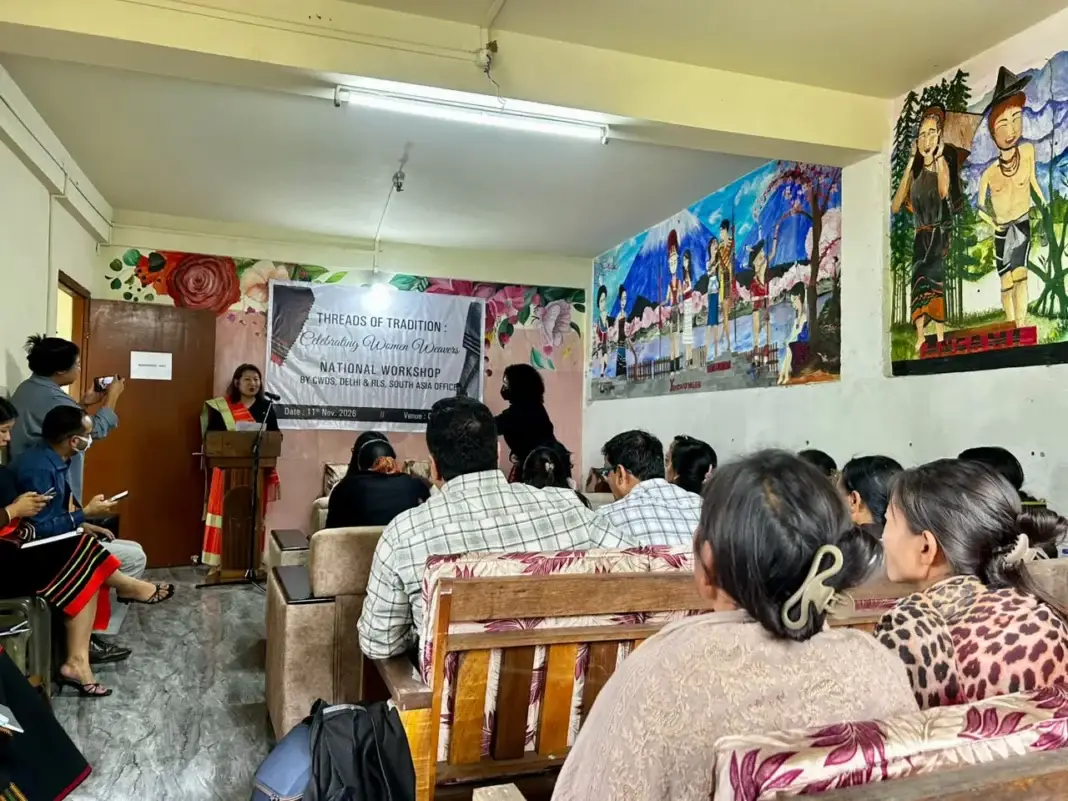
 Photo Courtesy: nagalandpost
Kohima: Women weavers gathered at Cradle Ridge Hall in Seithogei, Kohima, on November 11. They demanded better access to state welfare and institutional aid. The workshop, Threads of Tradition: Celebrating Women Weavers, brought together researchers, textile sellers, and government officials. It aimed to fix the gap between rural artisans and the support systems they need.
Prof. Rosemary Dzüvichü, director of the Centre for Peace and Gender Studies, led the push for change. She argued that schemes must reach the women who actually do the work. The project currently documents the lives of weavers from the Angami, Chakhesang, Rengma, and Yimkhiung tribes. It is a joint effort by the Centre for Women’s Development Studies and the Rosa Luxemburg Stiftung.
The craft is struggling. Mass-produced goods and cheap synthetic materials threaten traditional methods. Prof. Neetha, a coordinator from CWDS, pointed out the systemic lack of recognition for these artisans. She noted, “No one asks who weaves; they only look at the beautiful weaving.”
Weaving is not just business. It is a social marker of status and identity. Each piece tells a story through specific motifs and colors. Prof. Neeha Naqvi of RLS South Asia described the work as a labor of love. Abeni TCK Lotha, advisor to the Naga Mothers’ Association, urged the preservation of this heritage. She recently published Oying Motsü: The Story of Our Threads to document these designs.
Weavers held sessions with representatives from the North Eastern Development Finance Corporation Limited, the Nagaland Handloom and Handicrafts Development Corporation Ltd., and the Investment and Development Authority of Nagaland. They also displayed their products at an exhibition-cum-sale. The event focused on creating direct links between these local makers and town sellers.


Comments