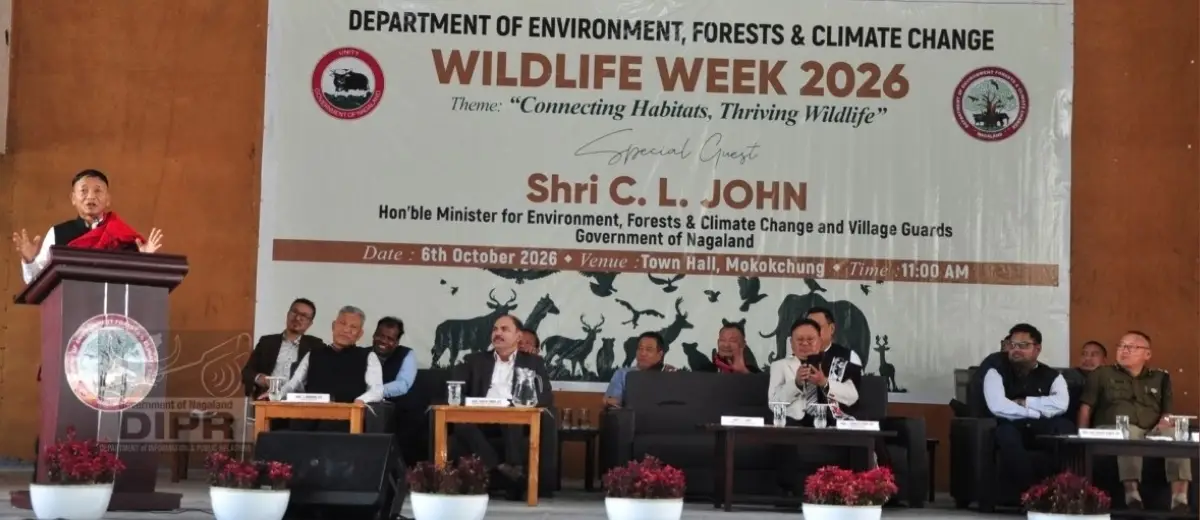
 Photo Courtesy: nenow
Kohima: Nagaland Minister CL John wants the killing to stop. During a Wildlife Week event in Mokokchung on Tuesday, the Forest, Environment and Climate Change Minister issued a blunt call to replace hunting with conservation. Nagas abandoned headhunting when Christianity arrived, he noted, yet animal hunting persists.
Wildlife Week runs from October 2 to 8. The minister praised the conservation success seen in two villages in Peren district and 141 villages in Mon district. These communities stopped killing animals and cutting trees years ago. They turned into guardians of their land.
"It is our shared responsibility to conserve and protect our wildlife that nature has provided us," John said. He urged teachers, church leaders, and local residents to take charge. Everyone must help educate their neighbors on the rules found in the Wildlife Protection Act.
Kikheto Sema, Development Commissioner and Principal Secretary, echoed the call for action. He spoke on the theme of Connecting Habitats, Thriving Wildlife. Sema pushed church leaders to promote the law from the pulpit. He wants students, village councils, and elders to join forces to protect the region.
Updated at 8th October 2026 at 9:49pm
Beyond the Mokokchung event, Wildlife Week 2026 reached districts across the state with a push to secure habitat connectivity. At the Kohima Forest Division, officials noted that the Wildlife (Protection) Act, 1972 has been in force in Nagaland since December 18, 1981. Local experts at the session warned that habitat loss, pollution, and the illegal trade remain persistent threats that go beyond government jurisdiction.
In the Wokha district, officials and legal authorities met at Old Ralan to link environmental health to rural livelihoods and water security. The campaign there tackled specific local frictions, including measures to mitigate human-elephant conflicts. Meanwhile, at the College of Veterinary Science and Animal Husbandry in Jalukie, students took part in poster competitions and technical lectures on how to keep development projects from slicing up wildlife corridors.
Conservationists point to the Doyang Amur Falcon initiative as the working blueprint for the state: success hinges on a mix of local community buy-in, government oversight, and active participation from the next generation of students.
Updated at 9th October 2026 at 3:00pm
Beyond the classroom and official meetings, the Nagaland Zoological Park in Dimapur ran a week-long cleanup and education drive. Students cleared 130 kilograms of plastic waste from the grounds and competed in wildlife essay and quiz challenges. Conservationists used the platform to present updates on the state's Asian Giant Tortoise reintroduction efforts and the ecological value of the Ntangki National Park rainforest corridor.
Authorities also sharpened the focus on legal accountability. At the Old Ralan event, officials addressed grievances from the Yamhon Area Public Organization and Ralan Area Lotha Hoho. Border Magistrate Tsenthungo Ngullie pressed local councils to master the specific penalties for wildlife crimes, aiming to turn village leaders into a more effective front line for enforcement.


Comments