 Photo Courtesy: India Today Group
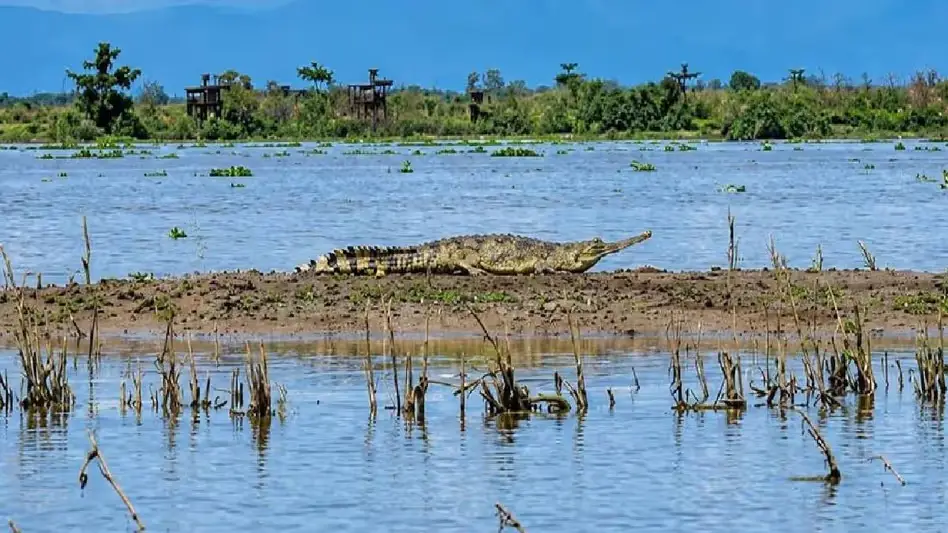
Guwahati: A critically endangered gharial appeared on a sandbank at the confluence of the Lohit and Brahmaputra rivers in Assam’s Tinsukia district. The sighting occurred on September 25, 2026. A joint biodiversity survey team from the Seed to Forest Foundation, the Balipara Foundation, and local community members captured the photos. Experts Manas Pratim Sharma and Sandip Chetri led the expedition outside of any protected zone, near the Dibru-Saikhowa-Brahmaputra area.
This crocodilian is a Schedule I species under the Wildlife (Protection) Act, 1972. It features a distinctively long, slender snout. The species once thrived across Indian river systems but faces severe population drops today. Dam building, sand mining, poaching, egg theft, and habitat destruction remain the primary drivers of this decline. Most surviving gharials now cluster within the Ganga basin, where a 2026 Wildlife Institute of India study counted 3,037 individuals.
Assam has seen very few recent records of the species. One animal appeared near Dibru-Saikhowa National Park in November 2022. Another showed up at Kaziranga National Park in May 2026. The Barak river system has reported no recent sightings. Researchers are now calling for broader, systematic monitoring to track these elusive reptiles across the Lohit and Brahmaputra systems.
Gautam Baruah, Chief Operating Architect of the Balipara Foundation, noted the importance of this work. He stated, "the sighting demonstrated the potential of community-based monitoring in documenting rare and threatened riverine species." Manas Pratim Sharma of the Seed to Forest Foundation echoed this, pushing for comprehensive surveys to better understand where these animals live and how they fare in the wild.







Comments