 Photo Courtesy: nenow
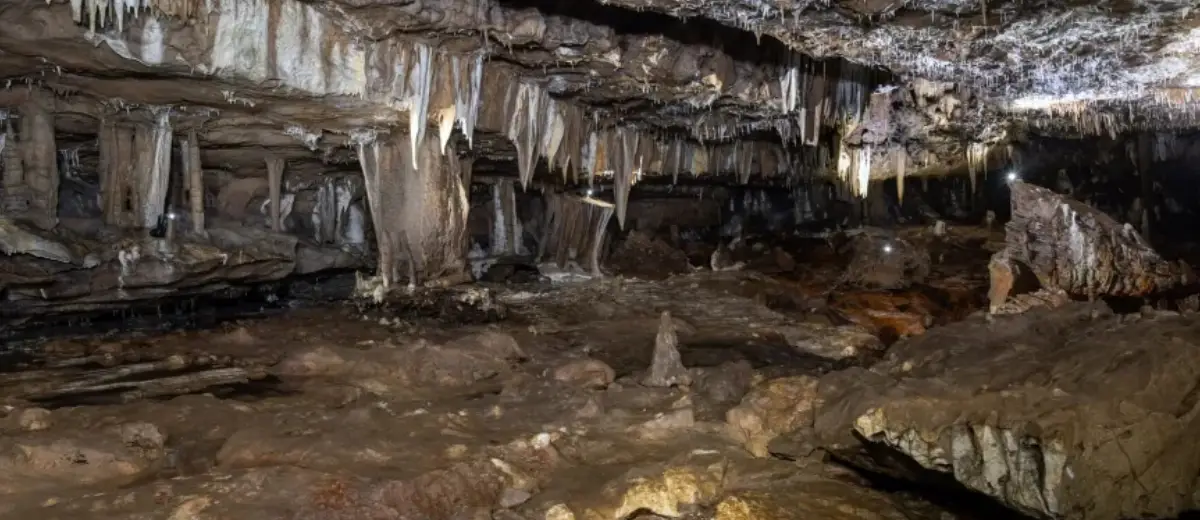
Shillong: Milton Marak leads visitors into the Mawmluh Cave near Cherrapunji. He carries a headlamp. There are no electric lights inside. The 27-year-old guide spent two years training to navigate the 7.2-kilometer passage without a map. His rules are simple. Do not touch the formations. Do not litter. Do not carve your name into the rock. Marak limits the Mawmluh cave to 25 visitors per day. He says, "We’ve deliberately kept the cave natural."
These limestone hills function as a climate library. Each drop of rainwater leaves minerals behind, creating stalagmites that log thousands of years of drought and monsoon shifts. Scientists use uranium-thorium dating to read this data. Sebastian Breitenbach, a paleoclimatologist at Northumbria University, says, "They are like books in a library." This record provided the geological marker for the Meghalayan Age, formally recognized in 2018. The site even holds evidence of a monsoon collapse 4,200 years ago that impacted the Indus Valley, Mesopotamia, and Egypt.
The climate is shifting. Erratic, heavy rainfall now floods these systems, bringing sediment that chokes growth. Yet, the most urgent threat is industrial. Cement quarrying and coal mining physically dismantle these geological structures. Jaishree Sanwal Bhatt, a geologist at the Jawaharlal Nehru Centre for Advanced Scientific Research, warns that mining is an irreversible threat. Unlike forests, caves cannot regrow. Even with a 2014 National Green Tribunal ban, illegal rat-hole mining persists. The state has registered over 1,000 cases since the prohibition. An explosion at an illegal mine in East Jaintia Hills killed 27 people and injured nine earlier this year.
Hidden inside these dark passages is a unique ecosystem. Explorers have found transparent freshwater shrimp, spiders, cave crickets, and white crabs. During a 2019 expedition, researchers discovered the Neolissochilus pnar, a cave-dwelling fish nearly a foot and a half long. Brian D. Kharpran, who founded the Meghalaya Adventures’ Association in 1990, has documented over 1,700 of the state’s estimated 2,000 caves. His organization has trained roughly 100 youth as guides to foster local stewardship.
Young residents like 24-year-old Quenty Mary Jallong and 22-year-old Wanpylnbiang view responsible tourism as a path to local jobs that do not require leaving their villages. However, experts note that local efforts need high-level support. Bhatt insists that conservation requires scientifically defined buffer zones and stricter mining regulations. Without these, the archive of Earth's history remains at risk of being lost to industry or neglect.




Comments