 Photo Courtesy: nenews
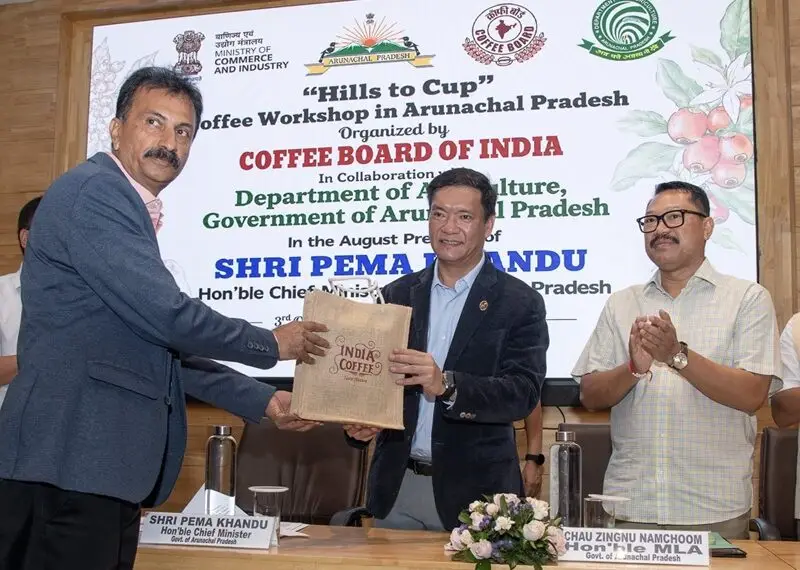
Itanagar: Arunachal Pradesh just held its first official coffee workshop. Growers from across the state gathered on Saturday in Itanagar to map out the future of local coffee production. The Coffee Board of India joined forces with the state Agriculture Department to host the event. It marks the state's first real push to turn coffee into a major agricultural and entrepreneurial force.
Coffee currently occupies 600 hectares of land in the state. Officials see massive potential for growth given the local climate. Chief Minister Pema Khandu wants more than just bigger harvests. He is pushing to establish a complete value chain to maximize profit for local farmers.
Khandu took to social media to highlight the importance of the event. He noted the goal is to drive long-term economic benefits for the region. "For the first time, coffee growers from across Arunachal Pradesh came together for an official Coffee Workshop, marking an important chapter in what could become a important part of the State’s agricultural and entrepreneurial journey," the chief minister said.
This event serves as the starting gun for coordinated state-led coffee initiatives. Future efforts will focus on expanding cultivation and refining the industry. The government plans to keep working closely with the Coffee Board of India to scale operations.
Updated at 4th October 2026 at 9:48am
The event, dubbed the Hills to Cup workshop, revealed that coffee is hardly new to the region. The crop was introduced nearly five decades ago, though it struggled to gain momentum until now. To jumpstart the current push, state officials spent time touring successful coffee operations in Andhra Pradesh, a move that prompted them to invite Coffee Board leadership to Itanagar for direct oversight.
Khandu emphasized that growing the bean is only half the battle. He wants the state to shift focus toward improving bean quality, processing, and mastering the supply chain to ensure farmers actually see better paychecks. A significant chunk of existing plantations currently falls under the management of the Arunachal Pradesh Forest Corporation in the eastern districts, while others are run as independent pilot projects.
The government is also eyeing the state’s booming tourism trade to move product. Khandu signaled that locally branded coffee could become a staple for travelers, offering a clear path for young entrepreneurs to jump into processing and retail rather than just raw cultivation. Technical experts from the Coffee Board are currently reviewing production hurdles and will submit a formal set of recommendations to the government to help guide future policy.
Updated at 4th October 2026 at 1:47pm
The event, dubbed the Hills to Cup workshop, revealed that coffee is hardly new to the region. The crop was introduced nearly five decades ago, though it struggled to gain momentum until now. To jumpstart the current push, state officials spent time touring successful coffee operations in Andhra Pradesh, a move that prompted them to invite Coffee Board leadership to Itanagar for direct oversight. A three-member team including a retired Principal Chief Conservator of Forests and the chairman of the Arunachal Pradesh Forest Corporation conducted the initial fact-finding missions.
Khandu emphasized that growing the bean is only half the battle. He wants the state to shift focus toward improving bean quality, processing, and mastering the supply chain to ensure farmers actually see better paychecks. A significant chunk of existing plantations currently falls under the management of the Arunachal Pradesh Forest Corporation in the eastern districts, while others are run as independent pilot projects.
The government is also eyeing the state’s booming tourism trade to move product. Khandu signaled that locally branded coffee could become a staple for travelers, offering a clear path for young entrepreneurs to jump into processing and retail rather than just raw cultivation. Technical experts from the Coffee Board are currently reviewing production hurdles and will submit a formal set of recommendations to the government to help guide future policy.




Comments