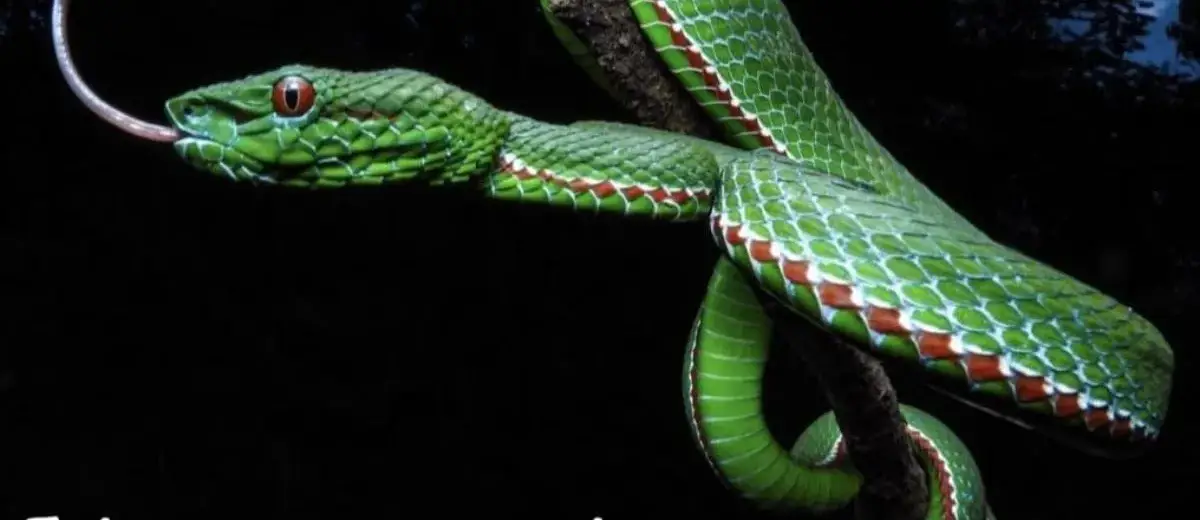
 Photo Courtesy: nenow
Aizawl: Scientists have produced a bivalent antivenom designed to neutralize the toxins of two green pit viper species native to Northeast India. The study, published in the International Journal of Biological Macromolecules, evaluated a formula targeting the red-tailed bamboo pit viper, Trimeresurus erythrurus, and Trimeresurus popeiorum. Researchers collected venom samples in Mizoram to build the experimental Bi-AV.
Current Indian medical practice relies on polyvalent antivenom meant for the Big Four snakes: the Indian cobra, common krait, Russell’s viper, and saw-scaled viper. These standard treatments often fail to protect patients bitten by the diverse snake populations in the Northeast. Rahul Kumar, Salima Siddika, Priyanka Gogoi, Nitin Salvi, Milind V. Khadilkar, M. Firoz Ahmed, Hmar Tlawmte Lalremsanga, Bhargab Kalita, and Ashis K. Mukherjee led the project.
Tests showed the new serum stops tissue damage and blood coagulation issues. It works better than standard commercial options. Mice treated with the Bi-AV showed improved survival rates during preclinical trials. The team also successfully tested the serum against T. popeiorum venom taken from snakes in Meghalaya. This suggests the treatment could work across different regions despite local venom variations.
Snakebites are a major health concern. One hospital study in Assam logged 92 cases of pit viper envenomation from April 2018 through August 2022. Many patients suffered from dangerous clotting abnormalities. The researchers stated, "The findings support further work on region-specific and species-targeted antivenoms, rather than relying exclusively on formulations developed around snake species found predominantly in other parts of India."
The Bi-AV is not ready for clinics yet. It remains in the laboratory and preclinical phase. Future work must include human clinical trials to prove safety and efficacy. Researchers now advocate for a systematic, regional approach to characterizing snake venom to better treat bite victims in Northeast India.





Comments