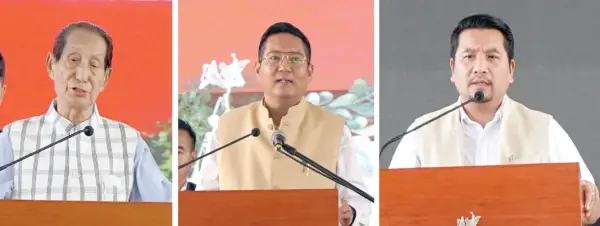
Kohima: Nagaland Director General of Police Rupin Sharma issued a blunt warning to local leaders on Monday. Village councils must stop handling major crimes. He spoke at a Capacity Building Programme held at the Kohima Village Multi Purpose Building on September 29.
The event aimed to train village functionaries. They often lack formal induction. This leads to power struggles. Sharma warned that village councils possess no authority to arrest citizens. They must report serious offenses to the police immediately. He specifically cited a disturbing case where a local body settled a rape charge with a simple fine. Sharma stated, "Serious offences and important criminal matters must be reported to the police."
Chief Secretary Sentiyanger Imchen pushed for accountability. He reminded the room that residents judge the government through basic services. This includes road access, health care, and water. Governance fails when leaders ignore these duties.
Nagaland Commissioner Gregory Thejawelie demanded better fund management. He pointed to the Village Development Board and the 1978 Village and Area Councils Act. He told officials to study the legal rules. They must stop issuing unauthorized Indigenous Inhabitant Certificates. They also hold clear duties regarding the Inner Line Permit system.
Kohima Deputy Commissioner B Henok Buchem organized the session for new village councils. The agenda spanned a wide range of laws. Topics included the 1937 Rules for the Administration of Justice and Police, the 2005 Communitization Act, and the 2026 Solid Waste Management Rules. Leaders also reviewed the Chief Minister’s Micro Finance Initiative, Ayushman Bharat-PMJAY, and land acquisition protocols under Article 371A. The session served as a crash course in ethics and administrative procedure.
Updated at 30th September 2026 at 5:47am
Chief Secretary Sentiyanger Imchen warned that the state lost large amounts of earmarked rural funding over the last three years due to a lack of audited accounts. He said the same mandatory requirements apply to the 16th Finance Commission grants running through 2031. He told leaders to treat every rupee as public money and demanded better documentation, transparency, and timely accounting.
Imchen also lashed out at village authorities for overstepping their bounds by summoning district officials and issuing ultimatums. He specifically criticized Gaon Burahs for opposing government decisions, noting that the state cabinet has taken serious notice of such defiance. He reminded them that Gaon Burahs are government appointees and must represent state interests at the local level.
The Chief Secretary urged officials to stop relying on personal relationships or influence when verifying certificates for residents. He also highlighted the need for village councils to play a proactive role in land acquisition for infrastructure, warning that the state cannot improve amenities if village leaders make unreasonable demands regarding land access.
Updated at 30th September 2026 at 1:50pm
Imchen also stressed the need for village councils to lead on environmental cleanup. He pointed to worsening plastic pollution, open burning, and contaminated water sources as threats that require local enforcement to fix. He also highlighted the importance of disaster management, noting that recent unforeseen events have claimed lives.
Addressing the role of Gaon Burahs, the Chief Secretary signaled a looming crackdown. He warned that the state cabinet is monitoring union leaders who openly oppose government mandates. "How can Gaon Burahs who are government appointees and representatives of the government in local bodies go against the government? The State Cabinet has taken serious note of this," he said.
Kohima Deputy Commissioner B. Henok Buchem revealed that the administration has compiled presentation materials into a handbook for village leaders. Officials have also distributed key legal documents translated into Tenyidie to ensure better compliance.




Comments